

Physics is a treasure trove of fascinating and mysterious phenomena that challenge our understanding of reality. These phenomena are not just theoretical musings — they are real, observable occurrences that shape our universe. Here are ten mind-boggling physics phenomena explained.
1. Quantum Entanglement: Spooky Action at a Distance
Quantum entanglement occurs when two particles become linked in such a way that the state of one particle instantly influences the state of the other, no matter how far apart they are. This phenomenon puzzled even Einstein, who famously referred to it as "spooky action at a distance." It challenges our classical notions of space and causality, playing a crucial role in the development of quantum computing and secure communication.
2. Black Hole Singularity: The Edge of Physics
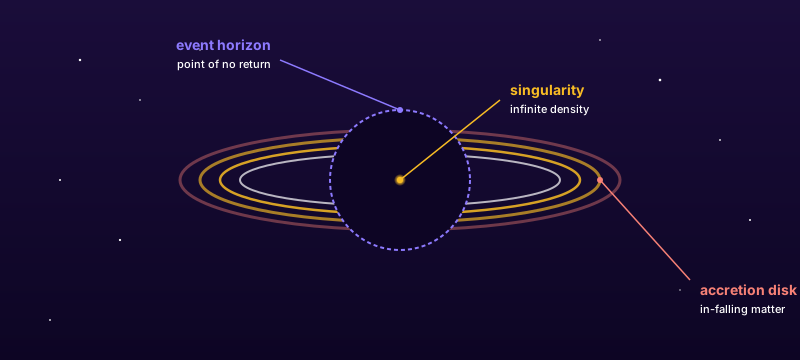
At the center of a black hole lies a singularity, a point where density becomes infinite and the laws of physics as we know them break down. Surrounding it is the event horizon, beyond which nothing — not even light — can escape. Black holes continue to intrigue physicists as they try to reconcile the singularity with quantum mechanics.
3. Time Dilation: Relativity in Action
Predicted by Einstein's theory of relativity, time dilation demonstrates that time passes at different rates depending on an object's speed and gravitational field. For instance, astronauts traveling at high speeds or experiencing weaker gravity age slightly slower than people on Earth — a concept famously verified by atomic clocks on satellites.
4. Wave-Particle Duality: The Nature of Light and Matter
In quantum mechanics, particles like electrons and photons exhibit both wave-like and particle-like behavior, depending on how they are observed. This duality, demonstrated through the famous double-slit experiment, defies our everyday understanding of objects and raises profound questions about the nature of reality.
5. Dark Matter: The Invisible Backbone of the Universe
Dark matter makes up about 27% of the universe but has never been directly observed. It doesn't emit, absorb, or reflect light, making it invisible. Scientists infer its existence from its gravitational effects on visible matter, like galaxies. Understanding dark matter is one of the biggest challenges in modern physics.
6. Superconductivity: Resistance-Free Electricity
Certain materials, when cooled to extremely low temperatures, can conduct electricity without any resistance. This phenomenon, known as superconductivity, has incredible applications, including powerful magnets for MRI machines and the potential for lossless power grids in the future.
7. The Higgs Boson: The Particle That Gives Mass
Discovered in 2012 at CERN's Large Hadron Collider, the Higgs boson is the particle associated with the Higgs field, which gives other particles their mass. Its discovery confirmed a key part of the Standard Model of particle physics and opened doors to understanding why matter has mass.
8. Cosmic Microwave Background Radiation: The Echo of the Big Bang
This faint glow of radiation permeates the universe, acting as a relic of the Big Bang that occurred 13.8 billion years ago. Observing the cosmic microwave background radiation allows scientists to peer back in time and study the universe's infancy.
9. Quantum Tunneling: Defying Classical Barriers
In quantum mechanics, particles can "tunnel" through barriers that they would not be able to pass in classical physics. This bizarre phenomenon underlies technologies like flash memory and nuclear fusion in stars.
10. The Arrow of Time: Why Time Moves Forward
Despite the laws of physics being time-symmetric, meaning they work the same forward and backward, we experience time as moving only forward. This one-way flow, known as the arrow of time, is linked to the concept of entropy and the Second Law of Thermodynamics.
These phenomena reveal just how mysterious and wondrous our universe truly is. They not only challenge our understanding but also inspire future generations of physicists to explore the unknown. As we continue to probe deeper into these mysteries, who knows what new discoveries await?