

Physics is the science of understanding how the universe works, and its history is a story of human curiosity, creativity, and persistence. From the ancient philosophers who first asked questions about nature to the groundbreaking scientists of the modern era, physics has evolved into one of the most profound and influential fields of knowledge. Let's take a journey through time to explore the milestones that shaped it.
1. Ancient Foundations: Aristotle and Early Natural Philosophy
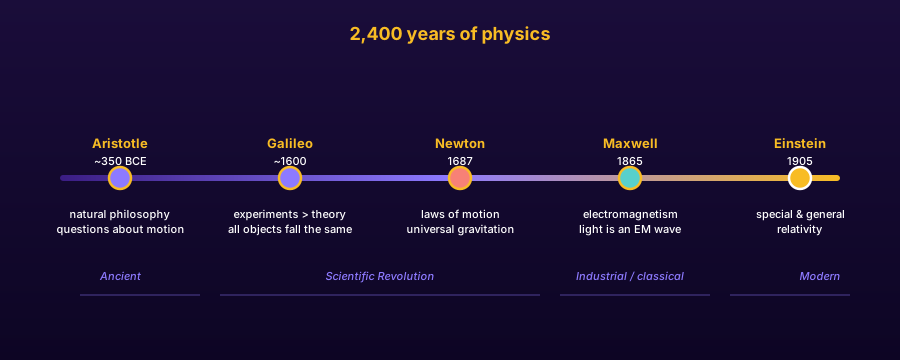
In ancient Greece, thinkers like Aristotle (384-322 BCE) laid the groundwork for physics by asking fundamental questions about motion, matter, and the cosmos. Although many of Aristotle's ideas—such as the belief that heavier objects fall faster—were later disproven, his work was vital because it introduced systematic study and logical reasoning about nature.
Other Greek philosophers, like Democritus, proposed the concept of atoms—tiny indivisible units of matter—a bold idea that wouldn't gain scientific traction until thousands of years later.
2. The Scientific Revolution: Galileo and Newton
The Renaissance sparked a new way of thinking. In the 16th and 17th centuries, experimentation and mathematics replaced speculation.
- Galileo Galilei (1564-1642) is often called the "father of modern science." He challenged Aristotle's views with careful experiments, discovering that all objects fall at the same rate (ignoring air resistance) and improving the telescope to study celestial bodies.
- Isaac Newton (1642-1727) revolutionized physics with his laws of motion and universal gravitation. His masterpiece, Principia Mathematica, unified the physics of the heavens and the Earth under the same laws—a breathtaking achievement that dominated science for centuries.
3. The Rise of Modern Physics: Electricity, Magnetism, and Thermodynamics
The 18th and 19th centuries saw rapid progress fueled by industrialization and technological needs.
- James Clerk Maxwell (1831-1879) developed equations that unified electricity, magnetism, and light, showing they were all aspects of electromagnetic waves.
- Michael Faraday (1791-1867) made crucial discoveries in electromagnetism, inspiring new technologies like the electric motor.
- The study of heat and energy gave rise to thermodynamics, with scientists such as Sadi Carnot and Rudolf Clausius laying the foundation for understanding energy conservation and entropy.
These advances set the stage for the modern technological world.
4. Einstein and the Birth of Modern Physics
At the dawn of the 20th century, classical physics could no longer explain strange new discoveries. Enter Albert Einstein (1879-1955).
- His theory of relativity (special in 1905, general in 1915) reshaped our understanding of space, time, and gravity.
- Around the same time, pioneers like Max Planck and Niels Bohr developed quantum theory, explaining phenomena at the atomic and subatomic level.
Together, relativity and quantum mechanics transformed physics into the modern science we know today, opening the door to everything from nuclear energy to semiconductors.
5. From Einstein Onward
While our journey stops with Einstein, physics has continued to evolve with discoveries like the Higgs boson, black holes, and the exploration of the quantum realm. Yet, the legacy of the thinkers before him continues to guide today's scientists in their quest to unlock the universe's mysteries.
Final Thoughts
The history of physics is a story of evolving ideas—sometimes wrong, often revolutionary—that have steadily expanded humanity's grasp of the cosmos. From Aristotle's natural philosophy to Einstein's relativity, each step built upon the last, creating a powerful framework that continues to shape science, technology, and our view of reality.